
The short version
Neither is simply “better”
Mica is often the practical, compact and economical answer for general industrial heating. Ceramic becomes particularly valuable when higher temperatures or reduced outward heat loss justify its thicker, insulated construction.
Compact, responsive and economical
- Radial space is restricted
- The application is within the mica design’s temperature capability
- Close contact with the barrel can be maintained
- Complex holes, cut-outs or special shapes are needed
- Initial cost is an important part of the decision
Higher temperature and insulated construction
- The process operates at a higher sustained temperature
- Reducing outward heat loss is a priority
- A thicker heater can be accommodated
- The application benefits from conduction and radiant heat transfer
- Energy use over the heater’s working life matters more than lowest initial cost
Inside the heater
How the constructions differ
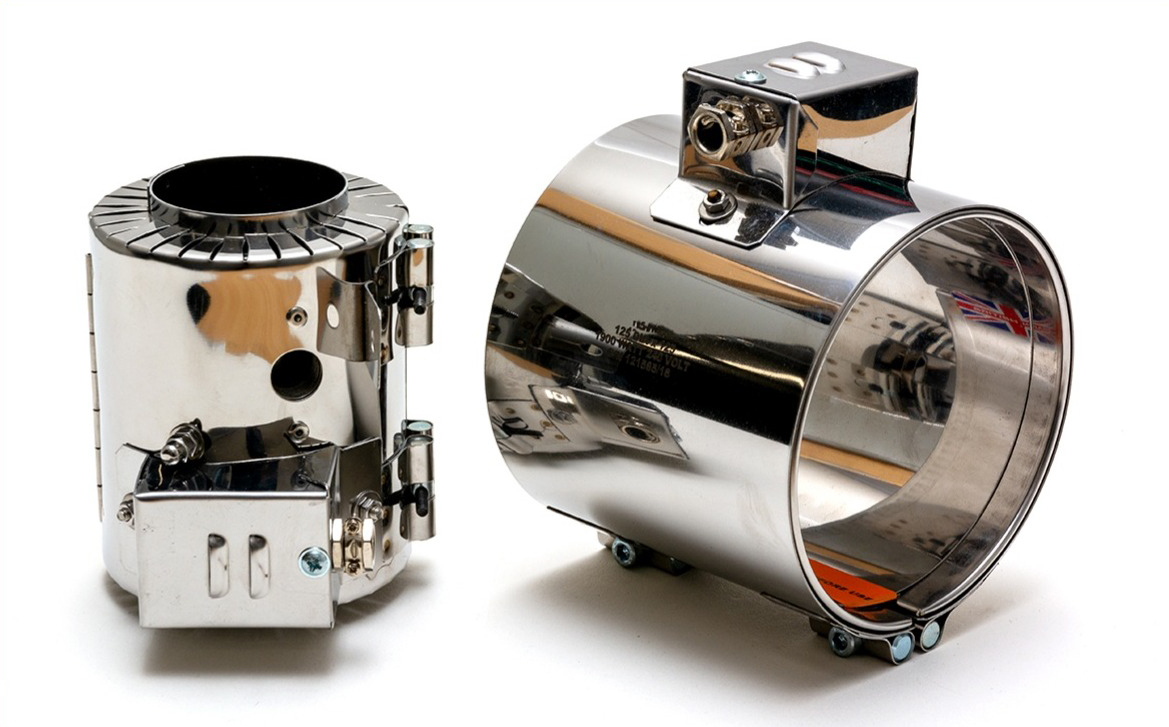
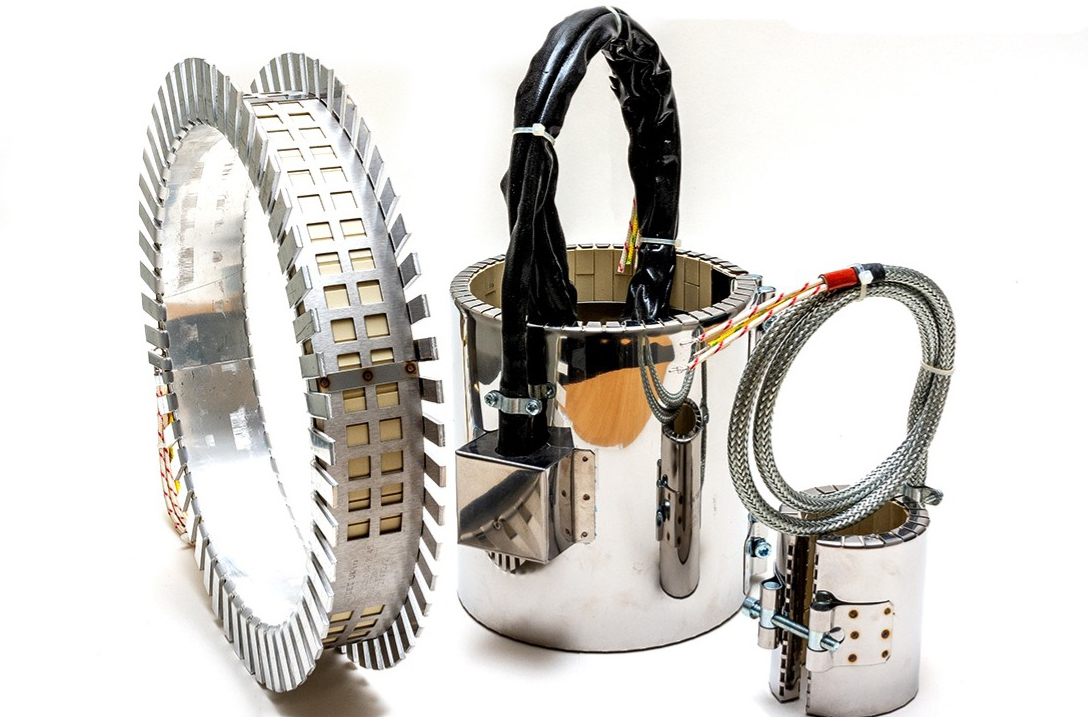
Mica: primarily contact heating
A resistance element is electrically insulated with mica and enclosed by a metal sheath. Heat passes primarily by conduction into the barrel, so good contact and effective clamping are important.
Ceramic: conduction and radiation
A resistance coil is supported through interlocking ceramic sections. The inner face transfers heat by both radiation and conduction, while insulation behind the ceramic assembly reduces heat travelling outward.
At a glance
Side-by-side comparison
Mainly conduction through close barrel contact
Conduction plus radiant transfer from the hot ceramic interior
Thinner and lighter
Thicker due to ceramic sections and backing insulation
Maximum design temperature: 300 °C
Maximum design temperature: 450 °C
30 W/in² (4.7 W/cm²)
45 W/in² (7.0 W/cm²)
Normally greater unless separate insulation is added
Built-in thermal insulation reduces external losses
Close fit and secure clamping are particularly important
Still requires correct sizing and installation, but radiant transfer makes it less dependent on perfect contact
Very adaptable for holes, cut-outs, separate circuits and varied termination arrangements
Bespoke features are possible, subject to ceramic layout and physical size
Usually the more economical construction
Usually a higher initial cost
Compact, proven heating at sensible cost
Higher-temperature duty and improved thermal efficiency
Make the decision properly
Six factors we would check
Process temperature
Normal temperature, maximum temperature and the length of time spent there all matter.
Required power
Heater size and wattage determine surface loading; more power is not automatically better.
Barrel condition
Diameter tolerance, surface condition and roundness affect fit and heat transfer.
Available space
Machine guards, cooling fans, wiring and adjacent zones may restrict heater thickness.
Heat loss and energy use
Operating hours, ambient conditions and insulation influence the value of an insulated construction.
Mechanical details
Holes, cut-outs, terminal position, leads, clamping style and installation access may decide what is practical.
A quick starting point
Which construction should I discuss?
Select the statements that best describe your application. This is a conversation starter, not final engineering approval.
Send us the application—not just the heater size.
We can consider the operating conditions and recommend a suitable construction.